
Recognising these warning signs early can help you avoid unnecessary tyre replacements while keeping your car safe, stable and comfortable on the road.
Why Even Tyre Wear Matters
Your tyres are the only parts of your vehicle in direct contact with the road. The tread must provide enough grip for steering, braking and accelerating, particularly on wet surfaces.
When a tyre wears evenly, its tread gradually reduces across the width of the tyre. Uneven wear means one area is deteriorating faster than another. This reduces the useful life of the tyre and can affect the way your vehicle handles.
Although a wear pattern can suggest a possible problem, it should not be treated as a complete diagnosis. A professional inspection may be needed to identify the underlying cause.
Common Tyre Wear Patterns
Wear on Both Outer Edges
Excessive wear along both shoulders of a tyre is commonly associated with underinflation. When the pressure is too low, the edges of the tyre carry more of the vehicle’s weight.
Driving with underinflated tyres may also increase fuel consumption, generate additional heat and make the steering feel less responsive.
Check the pressure when the tyres are cold and use the figures provided by the vehicle manufacturer. These can usually be found inside the driver’s door, inside the fuel flap or in the owner’s manual.
Wear Along the Centre
If the middle of the tread is wearing more quickly than the shoulders, the tyre may have been overinflated. Excessive pressure causes the centre of the tyre to make greater contact with the road.
Do not rely on the maximum pressure printed on the tyre sidewall. This is not necessarily the correct operating pressure for your vehicle.
Wear on One Edge
When the inner or outer edge of a tyre wears faster than the rest of the tread, it may indicate a wheel alignment issue.
Alignment can be affected by potholes, kerbs and general wear in steering or suspension components. You may also notice the car pulling to one side or the steering wheel sitting off-centre when travelling straight.
Feathered Tread
Feathering occurs when the edges of individual tread blocks feel smooth in one direction and sharp in the other. It can be difficult to see but may be noticeable when you carefully run your hand across the tyre.
This pattern is often associated with incorrect toe alignment and should be inspected before it causes further tyre wear.
Cupping or Scalloped Wear
Cupping appears as a series of irregular dips around the circumference of the tyre. Possible causes include worn suspension components, poor wheel balance or looseness within the steering and suspension system.
You may also experience vibration, increased road noise or a bouncing sensation while driving.
Flat Spots
A localised flat area may develop after heavy braking, prolonged storage or a problem that prevents the wheel from rotating normally.
Some temporary flat spotting can disappear as the tyre warms up. Persistent vibration or visible tread damage should always be checked professionally.
Other Signs That Your Tyres Need Attention
Uneven tread is not the only indication of a tyre or wheel-related problem. Arrange an inspection if you notice:
- The vehicle pulling or wandering
- An off-centre steering wheel
- Vibration through the steering wheel or seat
- Increasing road noise
- Regular loss of tyre pressure
- Cracks, cuts or bulges in a tyre
- Steering that feels less precise than usual
A bulge in the sidewall may indicate internal damage and should be treated seriously. Avoid continuing to drive on a visibly damaged tyre unless advised that it is safe to do so.
How to Check Your Tyre Tread
Park the vehicle safely on level ground, switch off the engine and apply the handbrake. Inspect the inner, centre and outer sections of each tyre rather than checking only the most visible area.
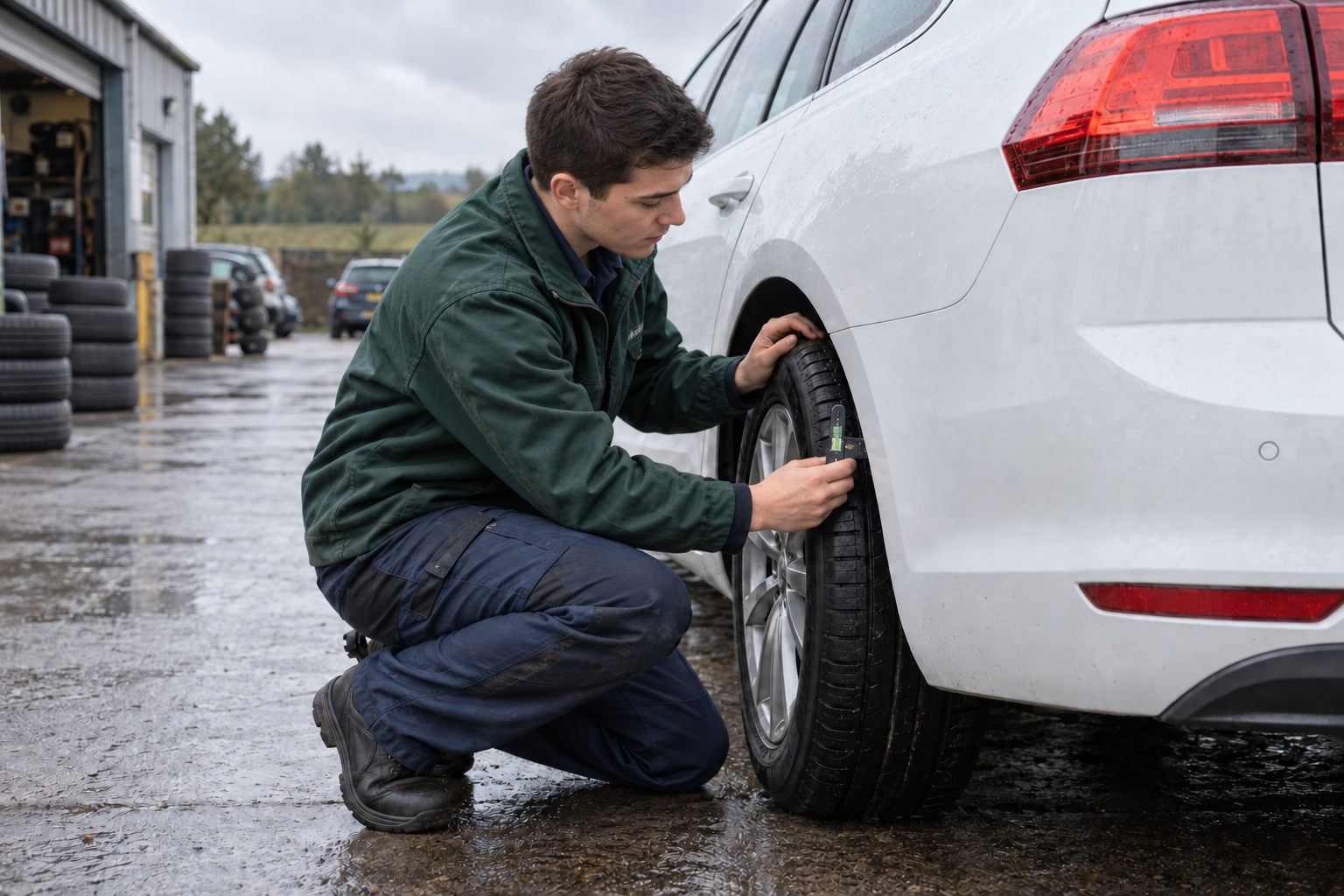
A tread-depth gauge provides the most accurate measurement. Where possible, check several points around the circumference because a tyre may not wear evenly all the way around.
In Ireland, the minimum permitted tread depth is 1.6 mm across the central three-quarters of the tread. For safety reasons, the Road Safety Authority recommends maintaining at least 3 mm of tread. The RSA also advises checking for defects such as cuts, bulges and tears. You can find further information in the RSA’s wheel and tyre maintenance guidance.
Tyre Pressure and Wheel Alignment
Correct tyre pressure helps the tread maintain consistent contact with the road. Pressures should be checked regularly and before long journeys, ideally when the tyres are cold.
If your car has a tyre pressure monitoring system, do not ignore its warning light. Correct the tyre pressures and investigate any continuing warning rather than simply resetting the system.
Wheel alignment should be checked if:
- The vehicle pulls to one side
- The steering wheel is not centred
- A tyre is wearing unevenly
- The car has struck a pothole or kerb
- Steering or suspension work has been completed
- New tyres are being fitted after irregular wear
Correcting the alignment before fitting replacement tyres can help prevent the same wear pattern from returning.
Do Not Ignore the Pattern
Uneven tyre wear is often a symptom rather than the complete problem. Replacing the tyre without addressing the cause may result in the new tyre wearing prematurely.
If you are concerned about your tyres, steering, wheel alignment or suspension, bring your vehicle to AutoSales Workshop in Sandyford. Our experienced technicians can inspect the wear pattern, identify the likely cause and recommend the appropriate repair or adjustment.
Early attention can extend the life of your tyres and help keep your vehicle safe, predictable and comfortable on the road.